Dutch theologian Herman Bavinck (1854–1921) is widely celebrated as a leading divine in the Reformed tradition, and through the ongoing labor of translation teams, editors, and publishers, his vast writings are reaching English readers.
This site — HermanBavinck.org — aims to make that access even easier. Here English readers will find a full list of Bavinck’s available works, updates on current translation projects, and a list of books and articles about Bavinck as they are announced.
Books by Bavinck (in English):
Reformed Ethics (Baker, 2019–). In 2010, Dirk van Keulen announced the discovery of a lengthy manuscript of a previously unknown Bavinck title on ethics, Gereformeerde 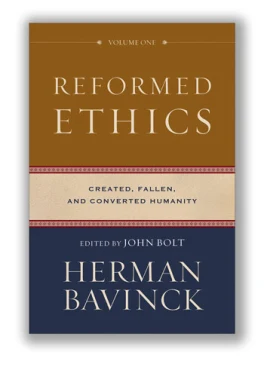 Ethiek, “a virtually unpublished monograph” hand-written in several notebooks. Keyed into Dutch, the long work of English translation commenced. But in 2012 project editor John Bolt made a further discovery: “the Bavinck manuscript was over 1,100 pages instead of the 560 total that we were working with. . . . Instead of a one-volume work, we are now projecting a three-volume work,” published through Baker Academic. “It is our goal to have the translated and edited volume one in the hands of the publisher by January 2017.” They delivered. Volume one, Created, Fallen, and Converted Humanity launched in May of 2019. Volume two, The Duties of the Christian Life, in November of 2021. Volume three, Christian Life in Society, is coming on April 29, 2025. And an unfinished companion volume, I’ll call volume four, titled, Perspectives on Society, Culture, State, Church, and the Kingdom of God, launches on March 18, 2025.
Reformed Ethics, volume 4 of 4: Perspectives on Society, Culture, State, Church, and the Kingdom of God. Edited by John Bolt. (Baker, March 18, 2025).
Reformed Ethics, volume 3 of 4: Christian Life in Society. Edited by John Bolt. (Baker, April 29, 2025).
••• Reformed Ethics: The Duties of the Christian Life, volume 2 of 4, edited by John Bolt (Baker, 2021).
••• The Wonderful Works of God (Westminster Seminary, 2019). A beautiful new typeset hardcover edition of the English translation formerly known as Our Reasonable Faith (1956, 1977). This remains the best single-volume introduction to Bavinck’s theology.
Christian Worldview, a new translation by Nathaniel Gray Sutanto, James Eglinton, and Cory Brock (Crossway, 2019).
Sacrifice of Praise, a new English translation by Cameron Clausing and Gregory Parker, with a foreword from Scott Swain (Hendrickson, 2019). See the 1922 edition here.
••• Reformed Ethics: Created, Fallen, and Converted Humanity, volume 1 of 4, edited by John Bolt (Baker, 2019).
Philosophy of Revelation: An Updated and Annotated Edition, edited by Nathaniel Gray Sutanto and Cory Brock (Hendrickson, 2018). Read or download the 1909 version of this book for free here. Or through the Internet Archive here.
Foundations of Psychology (2018), a new translation by Jack Vanden Born, Nelson Kloosterman, and John Bolt.
Herman Bavinck on Preaching and Preachers, translated and edited by James Eglinton (Hendrickson, 2017).
The Christian Family (1912), translated by Nelson Kloosterman in 2012.
••• Reformed Dogmatics: Abridged in One Volume (Baker, 2011). The original four-volume work shrunk from 3,000 to 850 pages.
Saved by Grace: The Holy Spirit’s Work in Calling and Regeneration (RHB, 2008).
Essays on Religion, Science, and Society (Baker, 2008).
••• Reformed Dogmatics, Herman Bavinck’s magnum opus in four volumes (Baker, 2003–2008). The set has also been electronically formatted by Logos Bible Software.
••• Reformed Dogmatics. Volume 4 — Holy Spirit, Church, and New Creation (Baker, 2008).
••• Reformed Dogmatics. Volume 3 — Sin and Salvation in Christ (Baker, 2006).
••• Reformed Dogmatics. Volume 2 — God and Creation (Baker, 2004).
••• Reformed Dogmatics. Volume 1 — Prolegomena (Baker, 2003).
In the Beginning (1999).
The Last Things (1996).
Foundations of Psychology (1981).
The Certainty of Faith (1903, 1980). Translated into English by Harry der Nederlanden. Purchase the book here ($15) or download a free, though imperfect, version of the PDF here (0.5MB).
Biblical and Religious Psychology (1974).
The Doctrine of God (1951, 1977).
Christian Education, a summary by Brederveld (1928).
Calvin and Common Grace (1909). Originally published as a chapter in Calvin and the Reformation. Read or download the 1909 version of this book free here.
Christelijke Wereldbeschouwing (The Christian Worldview). Dutch version only, this work needs to be translated eventually. See the Internet Archive for the 1904 or 1913 editions. Find the 2019 English translation here.
Books on Bavinck (in English):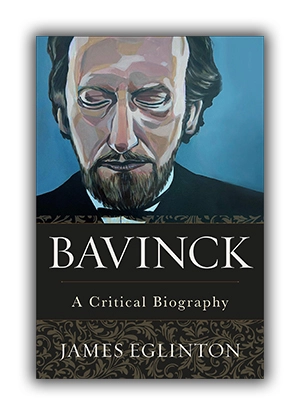
Nathaniel Gray Sutanto, God and Knowledge: Herman Bavinck’s Theological Epistemology (T&T Clark, 2021).
••• James Eglinton, Bavinck: A Critical Biography (Baker, 2020). Writes John Bolt: “In James Eglinton, Herman Bavinck has the biographer he so richly deserves, his own Scottish James Boswell. Using fresh archival sources, Eglinton provides new insights into the man, the churchman, and the thinker who was, alongside Abraham Kuyper, the most important figure in the revival of Dutch Calvinism in the nineteenth and twentieth centuries. Through careful historical research Eglinton places Bavinck in his broader intellectual and spiritual context as a modern person and effectively challenges some of the oft-repeated myths about him and his secession Christian Reformed community. This will be the definitive Bavinck biography for generations.”
Nathaniel Gray Sutanto, God and Knowledge: Herman Bavinck’s Theological Epistemology (T&T Clark, 2020).
Cory C. Brock, Orthodox Yet Modern: Herman Bavinck’s Use of Friedrich Schleiermacher (Lexham, 2020).
Craig Bartholomew, Contours of the Kuyperian Tradition: A Systematic Introduction (IVP, 2017). A book clearly focused on Abraham Kuyper, but the author so frequently offers a sweeping synthesis of the theological worldview he shared with Herman Bavinck, it’s worth mentioning here.
••• John Bolt, Herman Bavinck on the Christian Life: Following Jesus in Lawful Obedience (Crossway, 2015). A brilliant synthesis of Bavinck’s theology as it applies to the Christian life. The book concludes with 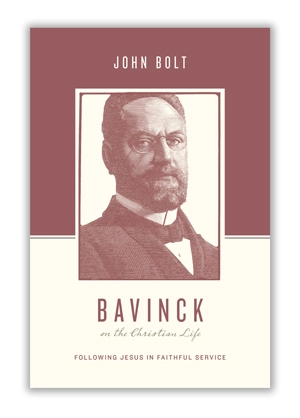 “The World-Conquering Power of Faith” (1 John 5:4b), a previously untranslated sermon.
Daniel Strange, Their Rock Is Not Like Our Rock: A Theology of Religions (Zondervan, 2015). While not entirely devoted to Herman Bavinck, much of it is (and a fair bit to J.H. Bavinck). The book turns to Bavinck to resolve the question of why non-Christian religions flourish under God’s sovereignty.
James Eglinton, Trinity and Organism: Towards a New Reading of Herman Bavinck’s Organic Motif (T&T, 2014).
Brian G. Mattson, Restored to Our Destiny: Eschatology and the Image of God in Herman Bavinck’s Reformed Dogmatics (Brill, 2012). A compelling book arguing “the ‘engine’ that drives Bavinck’s signature emphasis, ‘grace restores and perfects nature,’ is nothing less or other than the doctrine of the covenant of works, both in its articulation of creation’s sub-eschatological state and its ‘built in’ eschatological destiny. It is this covenant framework that alone explains why redemption is both a restoration and a perfection of creation; it restores the corrupted image of God and perfects it to its eschatological destiny. It accomplishes what Adam had to become, bringing about the end of his journey, not the beginning. The organic relationship between nature and grace is, in fact, inexplicable apart from this eschatology; it is the reason why the ‘perfection’ of nature is not superfluous to its ‘restoration’” (241).
Ron Gleason, Herman Bavinck: Pastor, Churchman, Statesman, and Theologian (P&R, 2010). A full-length biography.
••• Eric Bristley, Guide to the Writings of Herman Bavinck (RHB, 2008).
Richard Gaffin, God’s Word in Servant Form: Abraham Kuyper and Herman Bavinck and the Doctrine of Scripture (2008).
Jan Veenhof, Nature and Grace in Herman Bavinck (2006).
 Herman Bavinck
2 thoughts on “Bavinck’s Books”